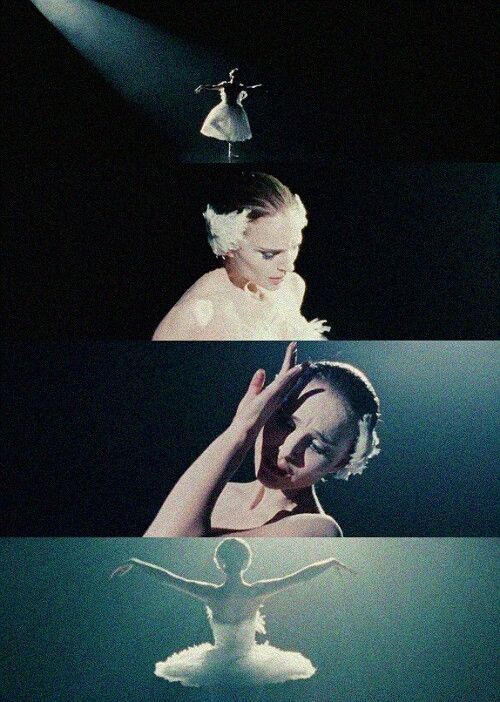
In 2010, Daren Aronofsky directed an extraordinary intoxicating masterpiece which I got to witness last week (after skipping my media class). As someone who has barely watched any Hollywood films, this one was the perfect icebreaker into the cinematic world. I regretted not watching this film earlier and referring to it during class. So here’s my insight
Fox pictures presents: Black swan (2010)
The film opens not with a realist image, but with a dream ballet: Nina Sayers performing the White Swan in a dark void. This choice immediately signals that the viewer is entering a subjective, unstable psychological landscape. This emptiness immediately signals dream logic, not objective reality. Nina’s inner world is a vacuum, a place where only her and her shadow self exist. The lack of environment isolates Nina visually and psychologically, she has no grounding except dance. From the first frame, Aronofsky makes it clear that this is Nina’s film, and that we will experience the story from inside her consciousness. The lighting is lowkey, black, greys and white dominating the frame. Scene appears to be colourless. Nina, dressed in pure white, is the only object fully illuminated. The white symbolises purity, elegance, repression, fragility and naive nature. Her movement further establishes her graceful nature through slowed and soft movements. The camera remains stable. Wide shot registers only Nina, the spotlight and the stage. Nina seems to be practicing and rehearsing on orchestral music. The digetic sounds are matched with her movement. The handheld camera movement creates a sense of claustrophobic identification with Nina, it mimics the instability and fragility of her mental state even before the plot reveals it. The camera stays close to her body, almost over her shoulder, limiting the viewer’s awareness to what Nina sees or imagines. The stage around her is pure darkness indicating that this is a mental projection, not an objective event. The void like stage symbolizes Nina’s psychological isolation and her narrowing world, dance is everything, and everything else falls into darkness. Sound cues echo through the void, making the dream feel cavernous and unreal. Every breath and footstep is amplified, emphasizing the physical strain and vulnerability inherent in Nina’s perfectionism. Nina’s White Swan movements are precise, restrained, almost too controlled. Shooting from the floor, focusing solely on Nina’s feet, foregrounds the brutal physical reality of ballet. We witness a ground level shot that highlights the intricate and controlled moments performed by Nina. The only source of light seems to be the reflection of the spotlight against the stage. Nina is dehumanized and broken into different parts to focus on details, increasing the tenseion and pressure. It also Symbolizes the way ballet culture reduces dancers to technique, perfection, and discipline, mirrors the way Nina herself sees her body, not as self, but as an instrument that must obey. Many of her movement involve circling around in the reflection of light on stage. The tracking shot takes the audience into a vortex like feeling as if being pulled into an illusion. The camera dances with her turning the audience into a mirror or partner. As she sits down, the camera reveals her face, her pale face and makeup adds on to the innocence and fragility. Her hair are slicked back into a bun, her arms appearing as if they were wings. Her expressions make her seem curious and naive. She looks around gracefully. The scene shifts to a wide shot from her back. The handheld camera shot Produces a sense of claustrophobia and subjective immersion. Aronofsky uses strategic silence to heighten tension. Silence before hallucinations, silence in confrontation scenes, Silence during self-scrutiny moments in mirrors, Silence becomes a pressure cooker. In these moments, Nina’s paranoia is loud in its absence of external sound.It implies that Nina is being watched or pursued by herself, by others, or by her own anxieties. Mimics the instability, jitteriness, and hyper awareness of her mind. The jittery movements build up tension and hints incoming danger. The black swan appears colourless, completely blending into the void like atmosphere. My initial thought without context were: who is he? is it her twin, a hallucination, or a supernatural entity? Hence, the audience was definitely immersed. The dark figure emphasizes the binary opposites theory. The black colour symbolizes death, mourning, and evil, as well as power, elegance, sophistication, and authority. Spiritually, black symbolizes the unknown and mysterious of the universe. The audience can not fully determine what or who the black swan represents but there is a clear feeling of discomfort and fear in the scene. When the dark figure appears, the camera becomes more reactive, mirroring Nina’s fear and uncertainty, the movement appears to be animalistic and dominating. The dark figure circles, approaches, and subtly surrounds Nina, camera tracks the figure moving behind her closing distance. The figure doesn’t move in straight lines rather moves against Nina’s steps completely abandoning her rhythm. The movement here symbolizes deorientation and instability. The figure isn’t just attacking; he’s merging into her. The camera stalks Nina and acts as her hallucination. It waits at corners, it follows silently from behind, It moves toward her in long, slow pushes. As they move closer to the camera, we hear the heavy breathing, anxious steps and imperfections of Ninas dance. Her steps become uncontrollable. She appears as if trying to find a way out and looking around for help but the dark figure simply follows her and disrupts the frame. Her facial expressions completely change, her eyes signalling for help. There is frequent use of sudden push ins to highlight the anxiety and paranoia felt. The camera glides across mirrors so smoothly that real and reflected spaces merge. In some scenes, reflections behave incorrectly, moving differently than Nina. The music further grasps the audience and works as an enigma code. The dark figure turns into a monstrous creature with black horns, pale glowing dark eyes and shedding of feathers. the shadow figure awakens, feeding on intensity and transforming into its true monstrous form. The blackness also suggests death of innocence, corruption of purity, and the duality of human nature. We see monstrous traits but it mirrors her movements. Now, heres my hypothesis; Her relentless pursuit of flawlessness fuels the creature. The more she tries to suppress her imperfections, the more monstrous they become when they finally surface. It is both her reflection and her opposite. Formed from the parts of her mind she refuses to acknowledge. The quick and uncontrolled movements suggests chaos and uncertainity. The creature is forcing the movement upon her therefore, she is repressed symbolising societal norms and restrictions or her own desire and pursuits that have become her shackles. As the creature lets her go, we see feathers from her dress falling apart and her desperately moving her arms. This signifies her exhaustion and search for stability. The camera moves around both the subjects in a circular motion, the same circular motion which was shown in the beginning using the ground level shot of her foot movement. As the camera moves into her face we see visible negative emotions, desperation, saddness (obviously) and fear. However, there seems to be signs of acceptance in her body language. The camera circles around her and gradually turns into a dolly shot of Nina dancing. Her movement symbolizes that of a swans. The elegance, the moving of arms like feathers and struggle to remain.
ladies and gentlemen,
Aronofsky isn’t just a director he’s a philosopher and artist. Anything that urges an individual to look within is surely art. We survive by fulfilling our needs and we live for art. Nina sayer is like all of us. She’d rather let her passion take her life instead of rotting slowly, leaving no proof of life.
Think of this as the last act. The music swells, the lights dim, and I exit the stage.
 Despair For Dummies
Leave a comment